For many years, Digital Marketing Funnels have played a central role in how businesses attract and convert customers online. These funnels were designed to guide potential customers step by step — from discovering a brand to making a purchase. Marketers relied on this structured approach because it was simple, predictable, and easy to measure.
However, the digital world has changed rapidly. Customer behavior is no longer straightforward, and buying decisions are influenced by many touchpoints. As a result, traditional Digital Marketing Funnels are no longer as effective as they once were. In today’s digital landscape, businesses must rethink how they approach customer journeys.
This blog explains what Digital Marketing Funnels are, why traditional funnels are breaking, and why modern marketing needs a more flexible approach.
Digital Marketing Funnels are models that represent the journey a customer takes before making a purchase. The funnel is usually divided into stages such as:
- Awareness
- Interest
- Consideration
- Decision
- Conversion
The idea behind Digital Marketing Funnels is simple: attract users at the top, nurture them in the middle, and convert them at the bottom. This approach worked well when customers followed a clear and predictable path.
Traditional funnels became popular because they:
- Are easy to understand
- Provide a clear structure
- Help track marketing performance
- Simplify decision-making for marketers
However, simplicity has now become a limitation.
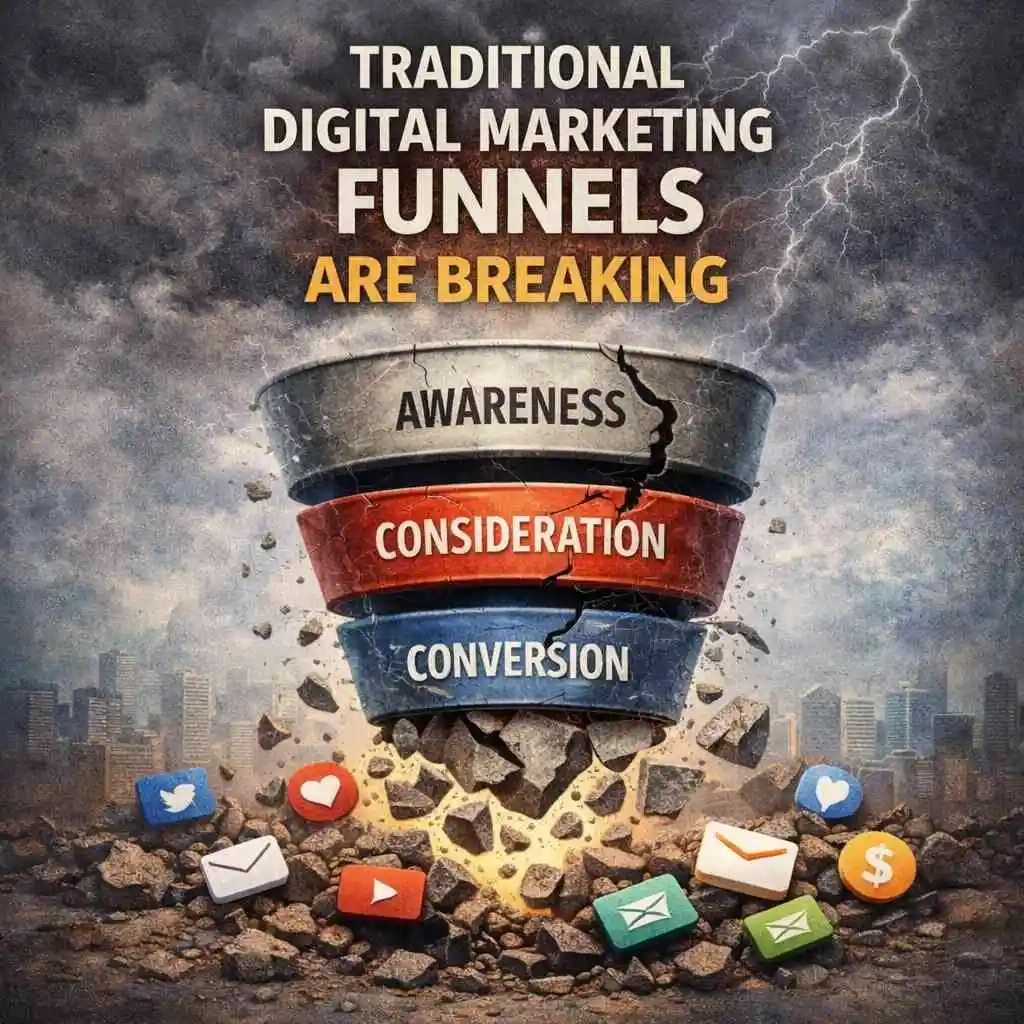
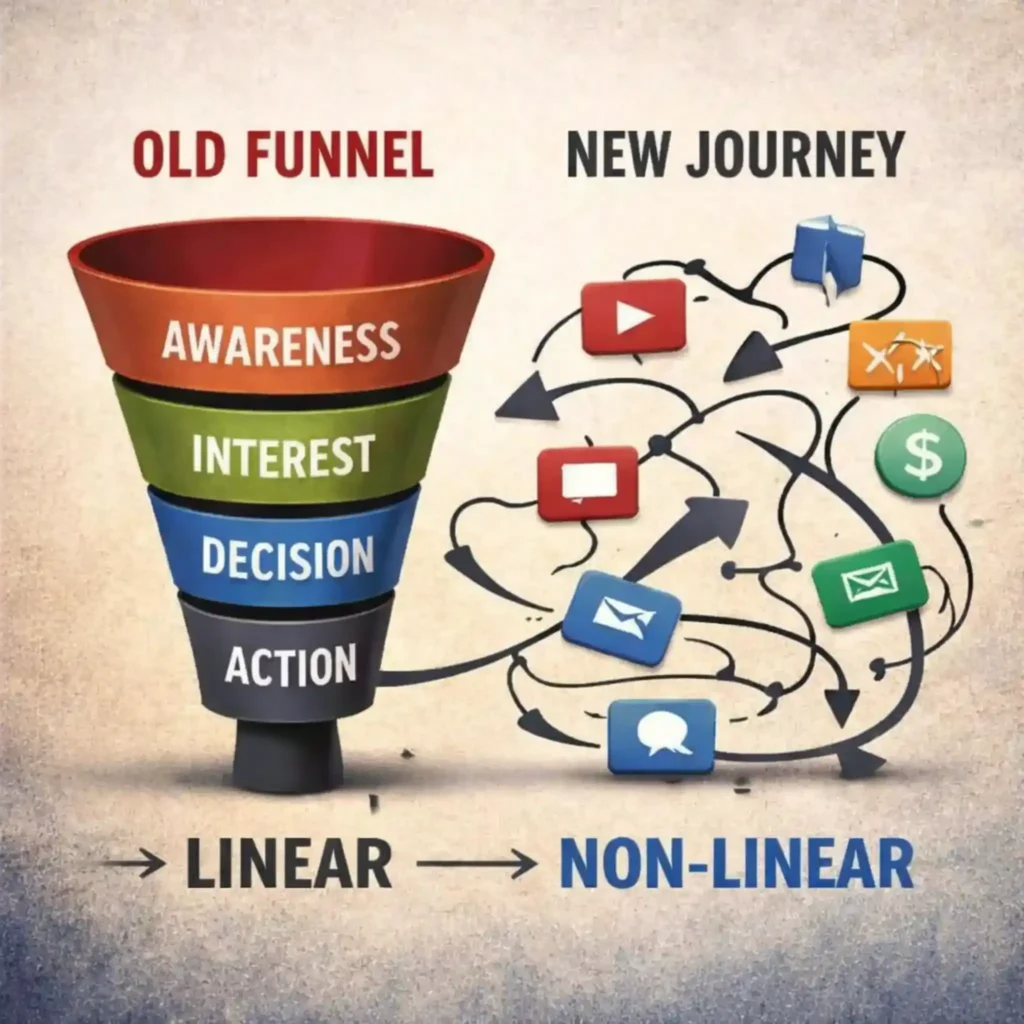
The biggest issue with traditional Digital Marketing Funnels is that they assume customers behave in a linear way. In reality, modern customers do not move smoothly from one stage to another. Instead, they jump back and forth, pause their journey, and return later.
For example, a customer may:
- See a brand on social media
- Ignore it for days or weeks
- Search for it later on Google
- Read reviews on another platform
- Watch a video about the product
- Finally make a purchase after a recommendation
This kind of journey does not fit into the traditional funnel model. As a result, Digital Marketing Funnels that rely on fixed stages fail to reflect real customer behavior.
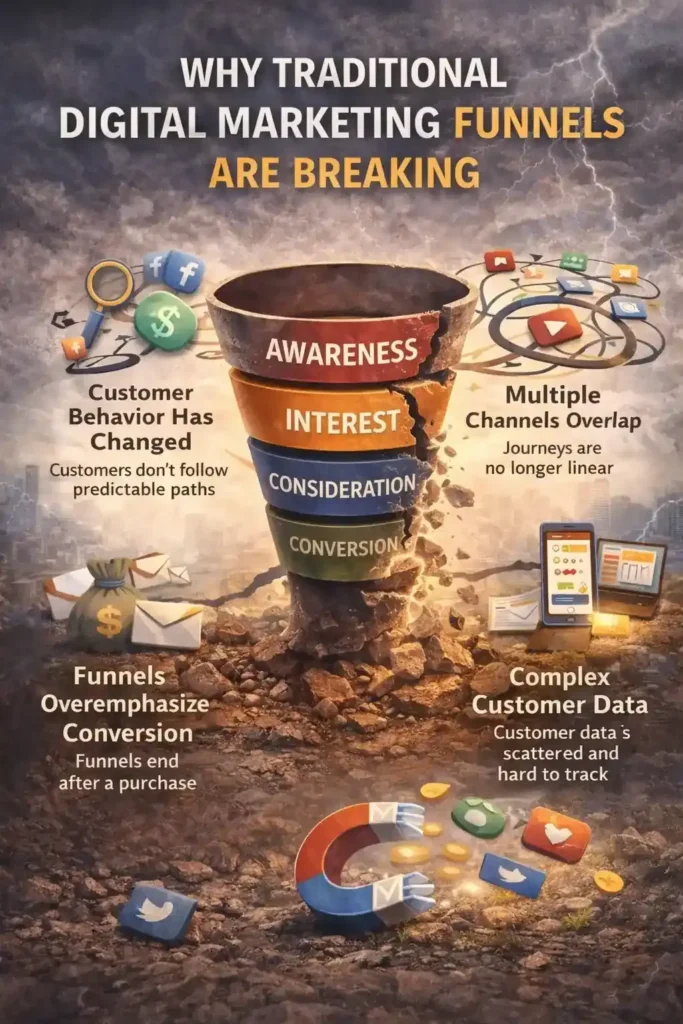
Customer Behavior Has Changed
One of the main reasons Digital Marketing Funnels are breaking is because customers have changed. Today’s consumers are more informed, confident, and independent.
Before making a purchase, customers often:
- Research multiple brands
- Compare prices and features
- Read reviews and testimonials
- Watch videos and tutorials
- Ask friends or online communities
Because customers have access to so much information, they control the buying process. Traditional Digital Marketing Funnels try to guide customers step by step, but modern buyers prefer to move at their own pace.
When businesses try to push customers too quickly through the funnel, it can feel forced and uncomfortable. This often leads to frustration, loss of trust, and abandoned purchases.
Multiple Channels Have Changed the Funnel Structure
In the past, customer journeys were limited to a few channels. Today, customers interact with brands across many platforms, including:
- Social media
- Search engines
- Websites
- Email marketing
- Online advertisements
- Messaging apps
Each channel can serve mult iple purposes at the same time. For example, social media can create awareness, build trust, provide customer support, and drive sales — all in one place.
Because of this, the stages of Digital Marketing Funnels now overlap. A customer might be in the awareness and decision stage at the same time. Traditional funnels, which separate each stage clearly, struggle to keep up with this reality.
Funnels Focus Too Much on Conversion
Another reason traditional Digital Marketing Funnels are breaking is their heavy focus on conversion. Once a customer makes a purchase, the funnel ends. This approach ignores what happens after the sale.
In modern marketing, long-term growth depends on:
- Customer retention
- Repeat purchases
- Brand loyalty
- Referrals and recommendations
Customers who have a positive experience are more likely to return and recommend a brand to others. Traditional Digital Marketing Funnels often fail to support these long-term relationships because they are designed mainly to close sales.
Trust and Customer Experience Matter More Than Ever
Modern customers are more doubtful of marketing messages. They are less responsive to aggressive advertising and hard-selling techniques. Instead, they value honesty, transparency, and helpful content.
Traditional Digital Marketing Funnels often feel transactional, treating customers as leads rather than people. This can damage trust and reduce engagement.
Today’s customers prefer brands that:
- Provide useful and relevant content
- Answer questions clearly
- Offer personalized experiences
- Build genuine connections
Focusing on customer experience rather than just funnel stages leads to stronger relationships and better results.
Data and Tracking Challenges
Traditional Digital Marketing Funnels were designed for a time when customer data was limited and easy to track. Today, customer data is spread across many platforms and devices.
When data is fragmented, it becomes difficult to:
- Understand customer intent
- Track the full customer journey
- Personalize marketing messages
Without a complete view of customer behavior, Digital Marketing Funnels become less accurate and less useful.
Are Digital Marketing Funnels Still Relevant?
Despite these challenges, Digital Marketing Funnels are not completely broken. They still provide value as a basic framework for understanding customer intent and organizing marketing efforts.
However, businesses can no longer rely only on traditional funnels. Instead of treating funnels as rigid paths, marketers should see them as flexible guides that adapt to customer behavior.
The Future of Digital Marketing Funnels
The future of Digital Marketing Funnels lies in flexibility and customer focus. Businesses must stop forcing customers into predefined stages and start supporting them wherever they are in their journey.
Modern marketing strategies should:
- Focus on customer needs and experience
- Use data to understand behavior
- Connect multiple channels seamlessly
- Build trust over time
By moving beyond fixed funnels and adopting a more customer-centric approach, brands can improve engagement, build loyalty, and achieve sustainable growth.
Final Thoughts
Traditional Digital Marketing Funnels are breaking because they no longer match how people buy today. Customer journeys are complex, non-linear, and influenced by many touchpoints. While funnels still matter, the old way of using them is no longer enough.
Businesses that adapt by focusing on flexibility, trust, and customer experience will be better prepared to succeed in the modern digital world.